
While othering is known as a huge practice in the Western world or minority populations, what some people do not know, is that this concept has reared its head into a country in the east as well: India. The historical Bollywood film, Padmavat, directed by Bhansali details the life of princess Padmavat as she marries a Hindu prince, but quickly becomes the object of obsession of a Muslim King at the time, Alauddin Khilji. While this movie is praised for its beautiful cinematography, acting, and musical numbers, there are many problems in terms of misrepresentation and othering that take place in this movie as well.
To start, the character of Alauddin Khilji is plagued with extreme othering and in a way plays into various middle Eastern stereotypes. He is constantly dressed in dark clothing, appearing in stark contrast to the often white dressed Hindu king. He is portrayed as someone who is a savage, through his loud behavior and barbarism that is demonstrated through his violent and inhumane practices of killings. This movie was directed by someone who is Hindu, so this type of natural portrayal of the Hindus as the heroes and Muslims as the enemies are almost common in Bollywood movies. However, as we approach changing times and shifting of thoughts to be more inclusive, should we not wonder, when is Bollywood going to turn the tide? While majority of the population in India are Hindus, it does not change the fact that both Hindus and Muslims alike view Bollywood movies as essential to their culture and Indian nationalism.
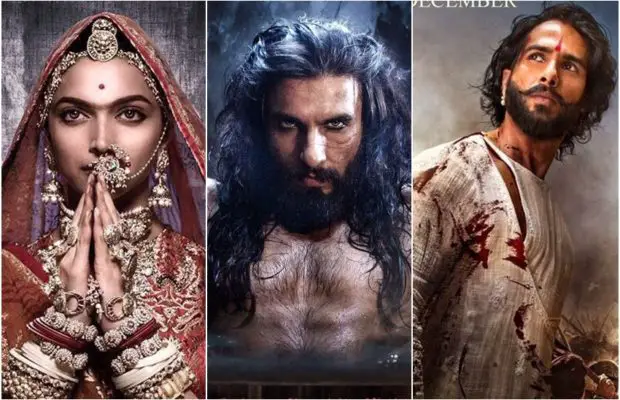
The second problem, is the historical inaccuracies. While many historical movies dramatize certain moments in history, it is not common that movies change big moments in history to fit a certain bias. Unfortunately, that is what this movie does. The Hindu prince, Ratan Singh, is portrayed as extremely righteous and noble. Historically, however, he is also known as someone who was rather violent, often going to extreme lengths to gain power, and ruling over his subjects with an iron fist. Many kings at the time, whether Hindu or Muslim, cared about what was best for the country, and was not considered about maintaining an upright character. In contrast, Alauddin Khilji is portrayed as cunning, ruthless, and a terrible person in the film. But historically he was known by his people for being mild tempered and rather pious. This again brings up the question, why was he even portrayed this way if it is a historical movie? If, in reality, their characters in the movie are opposite to how they were historically, would that not make for an interesting movie? Khilji as the hero and Singh as the villain?

The answer is tragic, yet harshly true. The movie would not be successful if this was how they were both portrayed. Many people in India do not like Muslim rulers, and since the majority of the country is Hindu, they have a certain view in their head of the Muslims that ruled them previously. Playing into this stereotype and othering them gives the viewer what they want to see, yet giving them a different narrative that is perhaps, more true is more of a risk, and might be a bit of a movie flop. This was a motive for the director to ensure a financial success.
Another important inaccuracy is the fact that in the movie, Khilji and Singh fight each other, and Khilji unfairly kills Singh by not abiding by the rules of combat. This sets up a binary opposition and others the Muslim population. Yet in reality, Singh was killed in a different war unrelated to his fight with Khilji. This inaccuracy makes me extremely upset. A part of the reason why many people side with Singh in this movie is this display of cunningness that he shows during the fight. But to know that this did not actually happen takes away some of the sympathy I felt for Singh when I first saw this movie. This fight seemed to fit this notion of Khilji as the “other”, because he was seen as the outcast in society because of his “savageness”, and killing Singh in a cruel manner seemed equally fitting. However, this is not what actually happened, further proving that this portrayal had motives to other the Muslim population in India and label them as outcasts.

I have a deep connection to Bollywood movies as a Hindu Indian American who sees Bollywood films as a way to connect to my culture and identity. However, this movie really disappointed me. As a Hindu, I do not want to see the same narrative played out in films. Growing up, I was also shown the same binary. Hindus are the noble people while Muslims are the cunning, deceitful, and evil characters. Hum Core and other classes that I have taken have shown me that this is not an actual opposition, and this needs to be changed. To me, it seems like Bollywood is almost one step behind, and this is somewhat making me lose my interest in something I loved so much. It seems like these films are forcing an identity on to me as a Hindu that I do not want. It is also trying to influence the way I view Muslim people in India that I do not want. All in all, this movie is a clear sign that things need to change in the Bollywood film industry. Othering and forcing binary opposition needs to stop, and Bollywood needs to rethink the way they are portraying various groups of people.
 Movie Mania
Leave a comment